Glass reacts to light differently from timber, plaster or painted metal. Instead of simply reflecting illumination from its surface, it can carry light through an edge, highlight polished boundaries and reveal textures that remain almost invisible under ordinary room lighting. This makes glass particularly effective for display cabinets, shelving, bars, retail fixtures and decorative partitions.
An aluminum profile designed for glass creates a controlled way to position the LED strip close to the glass edge. The profile supports the strip, keeps the light line straight and allows the installation to become part of the furniture rather than an exposed technical component.
Decide whether the goal is edge lighting or surface lighting
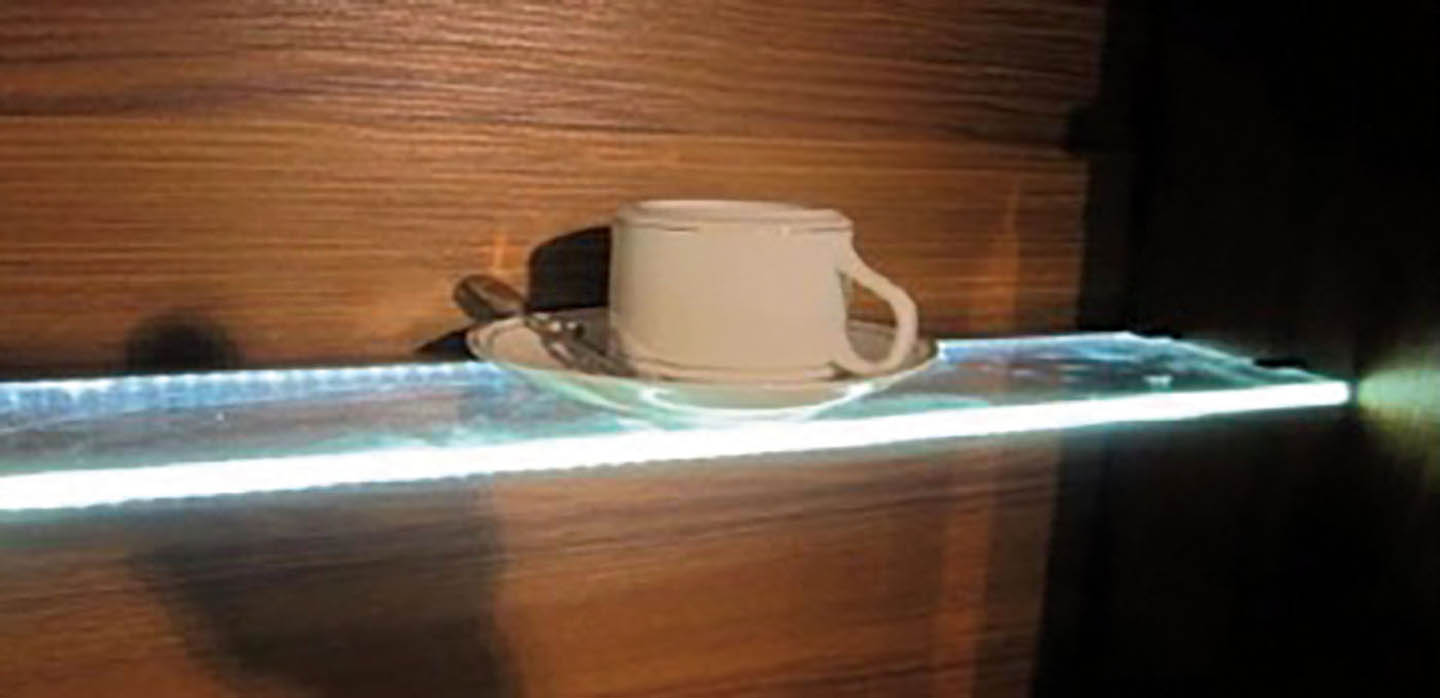
Glass can be illuminated in several ways. Edge lighting sends light into the thickness of the panel, where it travels through the material and becomes visible at polished edges, etched graphics or imperfections. Surface lighting directs light across objects placed on the glass or onto a nearby wall.
The effect depends on glass thickness, edge finish and transparency. Clear polished glass produces a crisp edge effect, while frosted or textured glass scatters more light across the panel. Tinted glass changes the colour and intensity of the result.
A dedicated Aluminum profile for Glass helps position the LED source consistently along the panel so the illumination remains even from one end to the other.
The relationship between strip and glass is critical
Small changes in position can produce very different results. If the LED strip sits directly against the glass edge, more light enters the panel. If there is a gap or the strip is offset, part of the output can escape into the surrounding space instead.
For shelf lighting, this can be used deliberately. Some installations emphasize the glass edge, while others use the profile to cast light downward onto products or decorative objects. The profile orientation should be selected according to the intended effect before the cabinet is assembled.
The strip width must fit inside the profile and align with the glass edge. A very wide strip in a narrow channel can create uneven contact or make the diffuser difficult to install.
Glass shelf lighting is especially effective in display furniture
Display cabinets often suffer from shadows because ceiling light is blocked by shelves and doors. Illuminating each glass shelf introduces light directly where the objects are placed. The transparent shelf keeps the furniture visually light while the LED line defines each level.
Retail displays can use neutral white light to show product colours clearly. Bars and decorative cabinets often use warmer tones for atmosphere. RGB or tunable lighting can create stronger visual effects, but the control system should be planned so that cables and controllers remain hidden.
The same principle works in residential shelving for glassware, collections or decorative objects. The lighting becomes part of the cabinet architecture and avoids the appearance of a separate fixture attached later.
Cable management should be planned with the furniture
Glass makes poor cable routing more visible because there are fewer opaque surfaces to hide wires. The electrical feed should pass through metal supports, furniture side panels or concealed channels before the glass is installed.
Where several shelves are illuminated independently, a vertical cable route can supply each level. Connection points should be positioned near the cabinet frame rather than in the centre of a transparent panel.
The power supply and controller belong in an accessible but hidden location. A removable base panel, service compartment or adjacent cabinet is preferable to sealing electronics permanently inside the furniture.
Diffusion changes the visual character
If the LED points are visible from the front of the cabinet, a diffuser can create a smoother line. Edge-lighting effects, however, may benefit from more direct optical coupling between the LEDs and the glass. The chosen profile and cover should support the desired effect rather than applying the same diffuser to every project.
COB strips are useful when a continuous line is important because the emitting surface is dense. Conventional SMD strips can also work well when the profile depth and diffuser provide enough mixing.
Brightness should be balanced against reflections. Glass surfaces can reflect the LED source and create duplicate lines. Lower output or careful angling often looks better than simply choosing the brightest strip available.
Glass partitions can use light as an architectural marker
Illuminated glass is not limited to shelves. A vertical glass partition can be lit from the top, bottom or side to create a luminous boundary between areas. Etched logos, patterns or frosted sections become more visible when light travels through the panel.
In offices and hospitality interiors, this allows a partition to serve both as a physical divider and a decorative element. The profile can be integrated into the base or frame so the light source remains discreet.
The installation should consider how the partition is fixed mechanically. Lighting components should not interfere with the hardware that carries the glass load.
Maintenance should remain straightforward
Dust and fingerprints are highly visible on illuminated glass. The profile should be positioned so the diffuser and exposed surfaces can be cleaned. Removable covers are useful because they give access to the LED strip if service is required.
If the glass shelf is removable, electrical connections should be arranged so the panel can be taken out without dismantling the entire cabinet. Plug connectors or accessible terminal points simplify future maintenance.
The installation should be tested before final assembly. It is much easier to correct uneven brightness or cable visibility while the cabinet is open.
Choose colour temperature around the objects being displayed
Warm white light brings out amber glass, timber and warm metals. Neutral white provides a cleaner presentation for general merchandise and contemporary furniture. Cooler light can emphasize clear glass and metallic surfaces but may feel too clinical in residential spaces.
Colour rendering remains important because the shelf often illuminates the objects directly. A good-quality LED strip allows materials and product colours to appear natural.
Treat glass lighting as part of the furniture design
The most convincing installations begin with the glass dimensions, support method and cable route before the lighting components are selected. The aluminum profile then becomes a structural lighting detail rather than a decorative add-on.
For projects involving profiles, strips and furniture lighting accessories, LEDUA offers components for building coordinated linear-lighting systems.
When the profile, strip and glass are planned together, the result can be subtle or dramatic without looking improvised. The light follows the material, emphasizes edges and objects, and gives transparent furniture a visual presence after dark while keeping the technical parts largely out of sight.